That Must Be the Catholic Eucharist Speaking Again Maybe a Belch
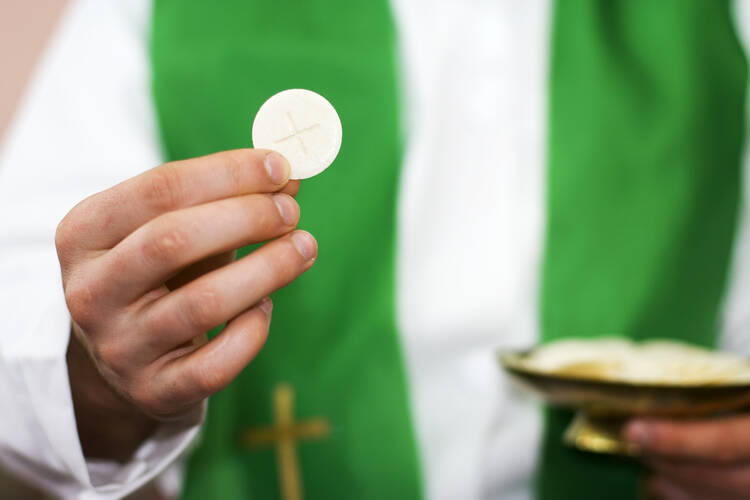 (iStock)
Have the "wafer wars" returned? The recent news that former Vice President (and electric current presidential candidate) Joseph R. Biden was denied Communion at a Catholic church in S Carolina suggests that a neuralgic issue for Catholics has once again reared its head: When is it permissible, acceptable or prudent to deny the Eucharist to someone?
In Mr. Biden'southward case, the Rev. Robert Morey, the pastor of St. Anthony Catholic Church building in Florence, S.C., decided that Mr. Biden's public pro-option opinion was reason enough to refuse him Communion on Oct. 27. "Sadly, this by Sun, I had to refuse Holy Communion to former Vice President Joe Biden," the pastor wrote in a statement responding to queries from the Florence Morn News. "Holy Communion signifies we are 1 with God, each other and the church building. Our actions should reflect that. Whatever public figure who advocates for ballgame places himself or herself outside of church teaching."
Mr. Biden's domicile diocese of Wilmington, Del., issued a argument on Oct. 29 that "[t]he Church's teachings on the protection of human life from the moment of conception [are] articulate and well-known. Bishop Malooly has consistently refrained from politicizing the Eucharist, and will continue to do so. His preference, as with most bishops, is to interact with politicians individually who disagree with significant church teachings."
The U.Due south. Conference of Catholic Bishops has traditionally given private bishops a great bargain of leeway to exercise their ain prudential judgment in deciding how and when to try to apply Cosmic teachings in their dealings with public officials. In 2004, the U.s.C.C.B. stated:
The question has been raised as to whether the denial of Holy Communion to some Catholics in political life is necessary because of their public back up for abortion on demand. Given the wide range of circumstances involved in arriving at a prudential judgment on a thing of this seriousness, nosotros recognize that such decisions rest with the individual bishop in accord with the established canonical and pastoral principles. Bishops can legitimately brand dissimilar judgments on the most prudent course of pastoral activeness.
In a 2004 essay released past the U.South.C.C.B. past the then-archbishop of San Francisco, Archbishop William J. Levada, asked:
Who is to estimate the country of a Catholic communicant's soul? Who may brand the decision to decline Holy Communion? Ministers of Holy Communion may find themselves in the situation where they must decline to distribute Holy Communion to someone in rare cases, such every bit in cases of a declared excommunication, interdict, or an "obstinate persistence in manifest grave sin." A classic instance is the exercise of a divorced and civilly remarried Cosmic who is publicly known to be in this situation and even so insists on presenting himself for Holy Communion. Here the 2002 Annunciation "Holy Communion and Divorced, Civilly Remarried Catholics" by the Pontifical Council for Legislative Texts indicated that when "precautionary measures have non had their effect or...were not possible," and the person in question still presents himself for Holy Communion with obstinate persistence, "the government minister of Holy Communion must refuse to distribute it."
However, Archbishop Levada reached a different conclusion in 2004 from that of Male parent Morey this calendar week:
With regard to Catholic politicians, the prudent practice for ministers of Holy Communion would be to refer any question in regard to their suitability to receive the sacrament to the bishop of the Diocese. Otherwise, the proficient reputation of the person might unnecessarily be jeopardized.
What does church law say? The relevant sections in the Catholic code of canon police force are canons 912, 915 and 916.
Different approaches
The incident with Mr. Biden reignited a furor that prominently figured in the 2004 presidential campaign, when the presumptive Democratic presidential candidate, Senator John F. Kerry, a Catholic, was criticized for his pro-choice political opinion also as questions regarding his divorce and remarriage. The so-archbishop of St. Louis, Raymond 50. Shush, told reporters that he would give Senator Kerry only a approving if he came forward for Communion. When he was bishop of the Diocese of La Crosse, Wis., then-Bishop Burke (who is besides a canon lawyer) publicly notified three state legislators that they were not to receive Communion because of their pro-choice stances.
Too in 2004, Cardinal Joseph Ratzinger, then prefect of the Congregation for the Doctrine of the Organized religion (he was elected Pope Bridegroom Sixteen the post-obit yr), released a certificate, "Worthiness to Receive Holy Communion: General Principles." Among its dictums was the following:
Regarding the grave sin of abortion or euthanasia, when a person'due south formal cooperation becomes manifest (understood, in the instance of a Cosmic politician, every bit his consistently campaigning and voting for permissive ballgame and euthanasia laws), his pastor should meet with him, instructing him about the church building's instruction, informing him that he is not to present himself for holy Communion until he brings to an stop the objective situation of sin, and alert him that he volition otherwise exist denied the Eucharist.
However, other canonists accept disagreed with the arroyo of Fundamental Shush or Cardinal Ratzinger. The Rev. John P. Beal argued in a 2004 article for America, "Fifty-fifty if a politician's views or votes can be adequately characterized as sinful, they practice non qualify as 'manifest' grave sin, as that word has been used in canonical tradition. For a sin to be manifest, information technology is not enough that it exist public or even notorious; information technology must also be so habitual that it constitutes an objectively sinful lifestyle or occupation."
In some other 2004 article for America, John Langan, Southward.J., noted that "political life in a modern democracy is complex and indirect. There is seldom a straight line from a value affirmed to a policy enacted. Governments are formed past coalitions, whose members have unlike priorities, fifty-fifty when they share many of the same values." That ways that "complex tradeoffs are an inescapable part of political life," Male parent Langan wrote. "Thus, a pro-life voter may be urged by a pro-life political leader to vote for a pro-choice candidate, because the pro-choice candidate is thought to take a better chance of keeping the political seat for the pro-life party."
Further, many have argued that there is a cardinal hypocrisy at piece of work when the simply reason someone is denied Communion is over his or her views on the legality of abortion, fifty-fifty though many Cosmic politicians hold views antonymous to Cosmic instruction on a number of other issues. John Gehring, the author of The Francis Issue, this week tweeted that "[w]hether information technology's confronting Democrats or Republicans, the Eucharist should never be turned into a political weapon. Pope John Paul II, a hero of the pro-life movement, gave Communion to pro-option politicians at the Vatican." (St. John Paul II gave Communion to Rome's pro-choice mayor, Francesco Rutilli, in 2001, and to Great britain'south pro-selection prime minister Tony Blair in 2003.)
"Denying Communion to politicians, Democrat or Republican, is a bad idea," wrote America'southward editor at big James Martin, South.J., in a Tuesday tweet. "If you deny the sacrament to those who back up ballgame, so you must as well deny it to those who back up the expiry penalty. How nigh those who don't help the poor? How almost 'Laudato Si'''? Where does information technology end?"
Canon 912 states that "Any baptized person not prohibited by law can and must exist admitted to holy communion."
What does church law say?
The relevant sections in the Catholic code of canon law are canons 912, 915 and 916. The outset, canon 912, states that "Any baptized person non prohibited by constabulary can and must be admitted to holy communion." As Father Beal noted in 2004, "Exceptions to this norm are to be interpreted strictly, i.e., by giving them the narrowest construal consistent with their literal meaning (Canon xviii)."
Canon 915, directed toward priests and eucharistic ministers, states that "[t]hose who have been excommunicated or interdicted subsequently the imposition or declaration of the penalty and others obstinately persevering in manifest grave sin are non to be admitted to holy communion."
Catechism 916, directed toward the individual communicant, states that "[a] person who is conscious of grave sin is not to celebrate Mass or receive the torso of the Lord without previous sacramental confession unless in that location is a grave reason and at that place is no opportunity to confess; in this case the person is to remember the obligation to make an act of perfect contrition which includes the resolution of confessing as before long as possible."
Pope Francis has stated that the Eucharist "is not a prize for the perfect but a powerful medicine and nourishment for the weak."
The devil in the details
The problem frequently lies in the application of catechism law. Mr. Biden clearly has not been prohibited past church law from receiving the Eucharist, and so it would seem that he "tin can and must be admitted to holy communion," co-ordinate to canon 912. Even so, priests similar Father Morey and bishops like Cardinal Burke seem to interpret canon 915 as the controlling legislation and have ended that pro-choice politicians like Mr. Biden are "obstinately persevering in manifest grave sin." In this view, catechism 915'due south prohibition overrides canon 912's presumption of access to the sacrament.
The denial of Communion to a Catholic suggests something more—a failure on the office of the Catholic Church to adequately convey essential truths near the sanctity of life.
However, as Father Aggravate noted in 2004, the deprival of Communion to a Catholic suggests something more than—a failure on the function of the Catholic Church to fairly convey essential truths about the sanctity of life:
Constructive educational activity requires something more than turning up the rhetorical book and brandishing anathemas. Resort to disciplinary measures similar refusal of Holy Communion is an implicit acknowledgment by church authorities that they have failed as teachers to convince Catholic politicians in particular and the larger lodge in general of the truth of the Gospel of life. Resignation to such a failure ill befits those who are charged to "proclaim the message; exist persistent whether the time is favorable or unfavorable; convince, rebuke, encourage with utmost patience in teaching" (2 Tim 4:2).
Giving the plus sign
Many priests, noted Father Martin in another tweet yesterday, were taught in seminary or studies to presuppose a person who presents himself or herself for Communion does so with a articulate censor and in a state of grace. "A priest has no idea what the country of a person's soul is when the person presents himself or herself in the Communion line. As we were taught in theology studies, the person may take repented of whatever sins and gone to confession immediately before Mass."
If the question of persevering in manifest grave sin involves public advancement for immoral laws, then a priest who denies communion could contend that repentance would require a public repudiation of that advocacy. Withal, Begetter Martin noted, "as Pope Francis has said, the Eucharist 'is non a prize for the perfect but a powerful medicine and nourishment for the weak.'"

Source: https://www.americamagazine.org/faith/2019/10/30/explainer-when-can-someone-be-denied-eucharist
0 Response to "That Must Be the Catholic Eucharist Speaking Again Maybe a Belch"
Publicar un comentario