how to draw 3d cartoons in illustrator
Cartoon a cartoon is no footling pursuit. It turns united states into a director, writer, narrator. Through a drawing or comic, you tell a story that takes place in a certain time, a certain environment, with certain characters.
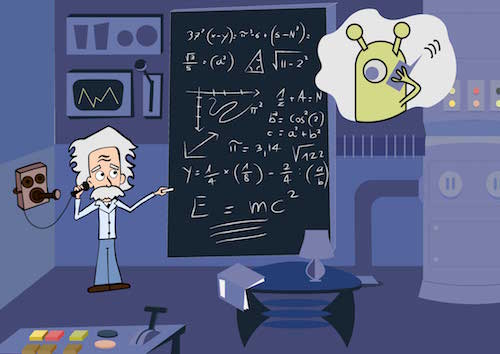
This is why you will learn here non simply how to draw a cartoon in Adobe Illustrator, but how to make up one's mind on character, place and situation. Before grabbing your pencil or software tool, ask yourself, "What will be my topic?"
- How many characters you will use, and who will they be?
- What background will they motion against?
- What era volition they alive in?
- In what scene will you put them?
Through the steps in this tutorial, I will explicate to you my ain choices. Let's brainstorm.
More after bound! Continue reading below ↓
Further Reading on SmashingMag:
- How To Create A H2o Lily In Illustrator
- forty Excellent Adobe Illustrator Tutorials
- Inspiring Illustrator Artworks By Artists Around The World
- Beautiful Photoshop Illustrations By Artists Effectually The World
1. The Subject
The topic I've chosen for my cartoon relates to a recent discovery. For the get-go time, we've picked up a betoken caused by gravitational waves. Albert Einstein first theorized the existence of gravitational waves in 1918. Heady!
So, what better topic for my cartoon?
ii. The Grapheme
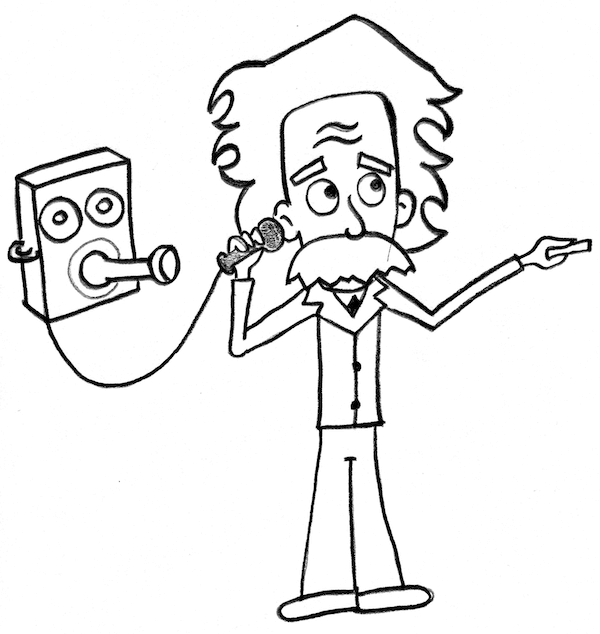
The character I'll draw, and so, is Einstein.
Open Adobe Illustrator.
Insert the file I've provided in Illustrator past going to "File" → "Place."
Now, adjust the artboard past going to "Object" → "Artboards" → "Fit to Artwork Bounds." The dimensions of your artboard should at present match the file you've just inserted: 2305 × 3250 pixels.
Block the layer where y'all've just put the file. Double-click on the layer'due south name and rename information technology "Sketch."
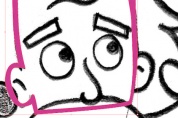
Create some other layer in a higher place the "Sketch" layer by hitting Command + L on a Mac or Control + L on Windows, and call information technology "Lines."
Now, we need to trace the image with the Pen tool (P), like to how I showed you in my previous tutorial.
What nosotros are going to learn here is not the mere tracing of shapes, but rather how to trace the black outline of a drawing.
We practice this because we are drawing a drawing, and cartoons usually accept this blackness outline around the shapes to distinguish them.
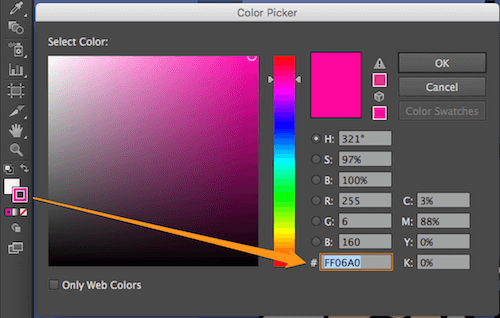
Double-click on the stroke's color, and prepare the hexadecimal value to #FF06A0.
Nosotros use this colour to distinguish our lines on the artboards. We will change it later.
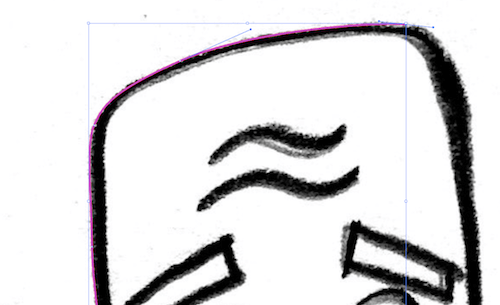
Zoom into the drawing at 200%, and begin to describe the face outline with the Pen Tool (P).
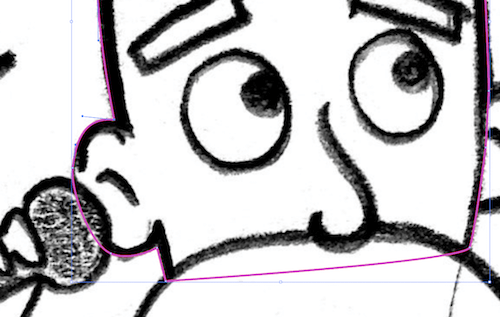
Exercise this until you've drawn the summit of the head.
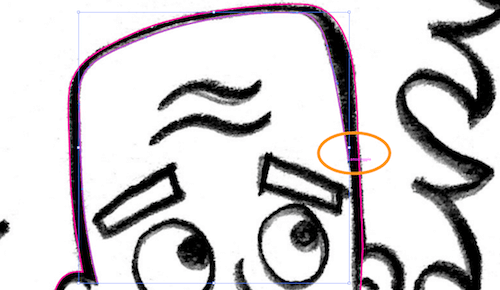
Once y'all've finished cartoon the caput'south outline, describe the internal outline.
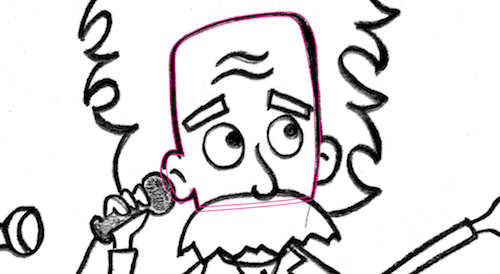
Now, select both outlines you lot've created, the external and internal one, and click on the Shape Builder tool (Shift + Thou).
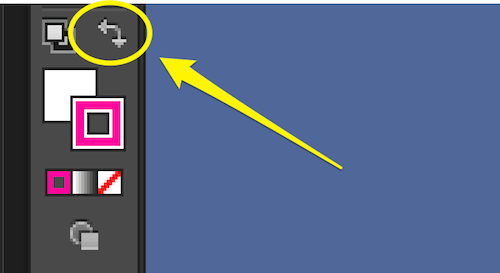
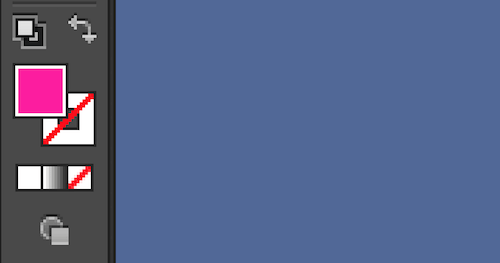
Get to the button to swap the fill up and stroke color (Shift + X), and click on that little arrow. The stroke'due south colour should now be inverse to the make full'southward color.
Now, enable the Shape Builder tool (Shift + M), and put the cursor in the empty space between the two outlines we created before. Y'all volition see something like a transparent background, which indicates the space where the Shape Builder tool will create a shape.
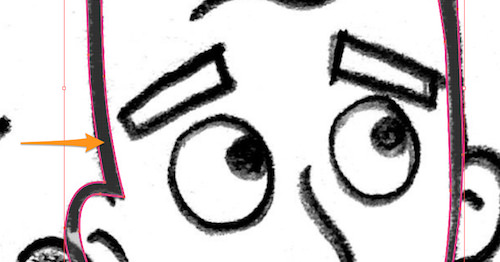
Simply click and yous will see the selected expanse be given the fill color.
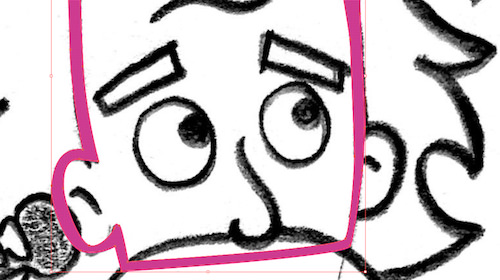
Thus, nosotros've created a fill up-colored outline for our cartoon.
At present, allow'southward repeat the same action with the other body parts: mustache, optics, ears, nose, pilus and so on.
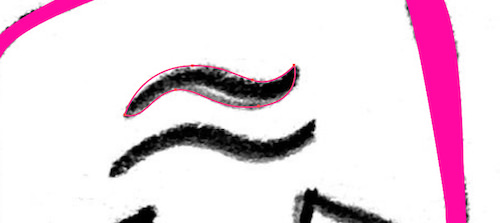
For the petty shapes, like the forehead wrinkles, you can just draw a closed shape and then swap the stroke with the fill.
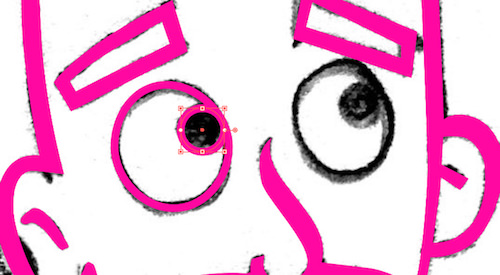
For shapes like the eyes, use the Ellipse Tool (Fifty) and set the stroke weight to 8 points.
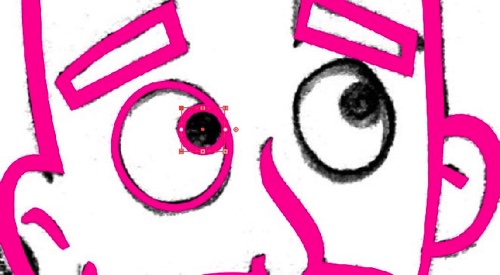
This is our piece of work so far. Observe how I've closed the paths, fifty-fifty if they cover the face. I did that because nosotros volition be able to make full the shape with color with just a click, only by creating a airtight path.
So, we will hide some parts, positioning 1 part over another. But nosotros will see that later.
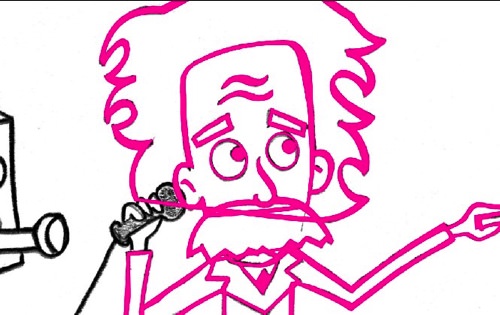
It'southward a piddling different for the paw holding the old phone. Hither, you have to draw the paw in ii shapes: the fingers and the palm. Practice it using Pencil Tool (Northward).
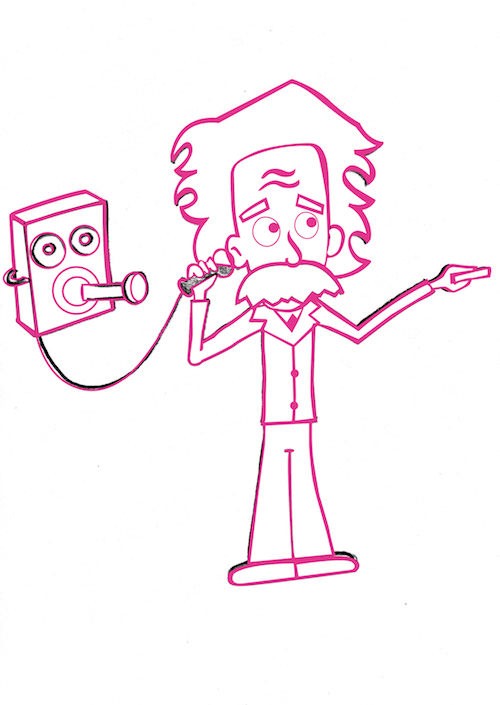
Et voilà! Here is our drawing:
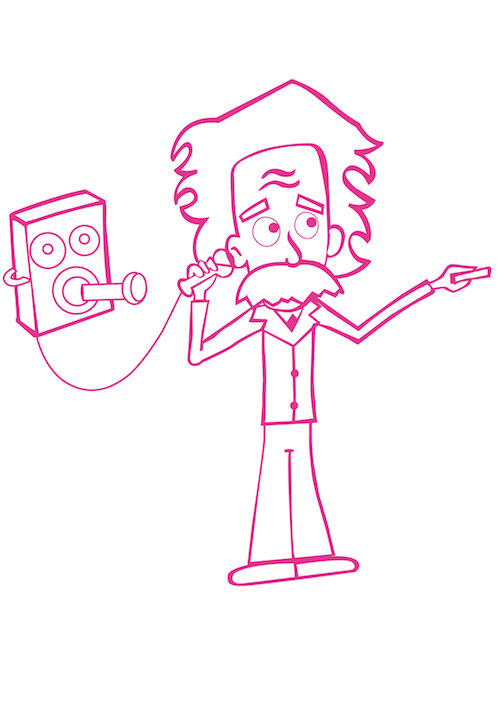
Hide the "Sketch" layer, and y'all will see your make clean vector.
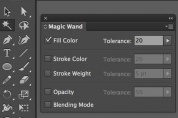
Now, double-click on the Magic Wand tool (Y), and select "Fill up Color" in the popup window, setting the tolerance to xx.
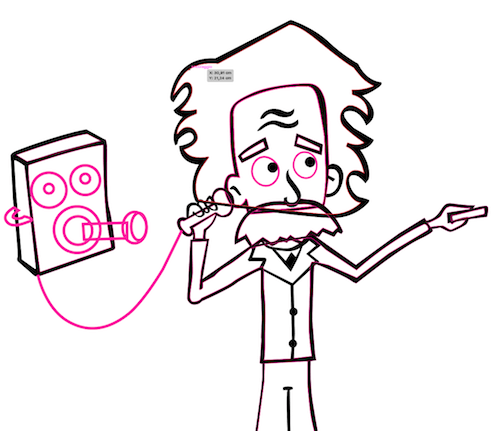
Afterward you lot've gear up the tool this way, it will select all objects with the same fill colour. Just click on your work to run across it in action.
After y'all've selected them, double-click on the fill colour and set it to #000000. Your paradigm should look like this:
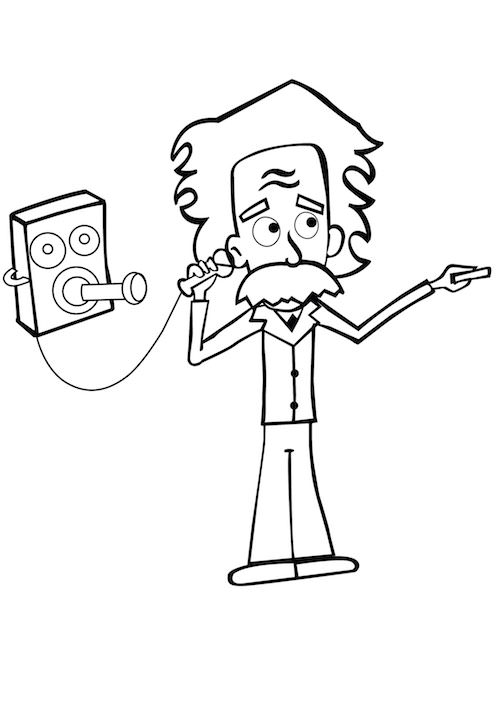
Double-click again on the Magic Wand Tool (Y) and select "Stroke Color," setting the tolerance to 20. Click on your prototype, and all strokes with the same color volition be selected now. Set the color to #000000.
Now, our epitome will have all black outlines.
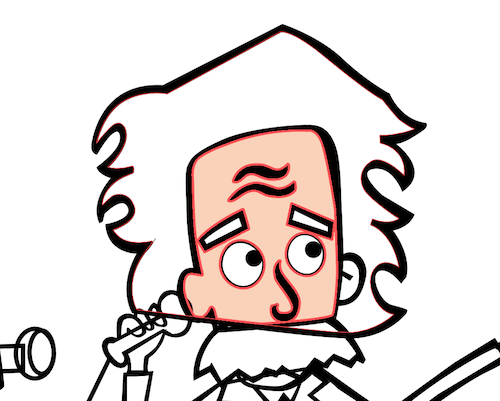
Permit's colour Einstein.
Set up the skin color to a hexadecimal value of #FBD2B7.
Select the head with the Selection tool (V), so click on Live Paint Saucepan (K). Click on the face to fill it with the selected color.
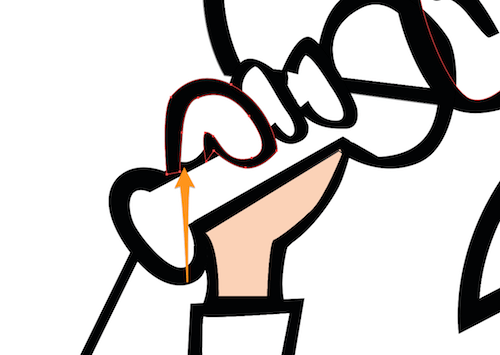
Do the same with the other shapes, giving them the aforementioned color: ears, chin, cervix, hands. Think that you have to select a group of objects first and then color them with the Live Paint Bucket (K), or else it won't work.
Annotation: If yous are not able to colour something with the Live Paint Saucepan (Grand), it probably ways your object has open up paths. It happened to me with the fingers:
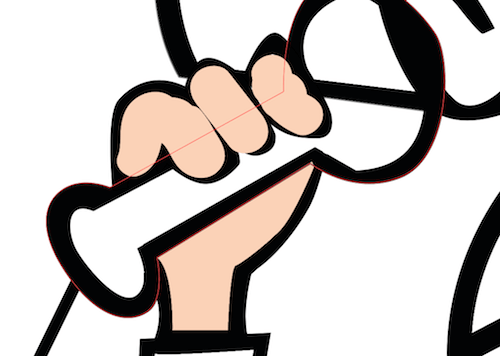
In this case, y'all can utilize the Blob Brush tool (Shift + B) to color the internal shape of the fingers. Gear up the color to #FBD2B7, ready the brush's weight to 30 points, and fill the fingers and other shapes that have open paths.
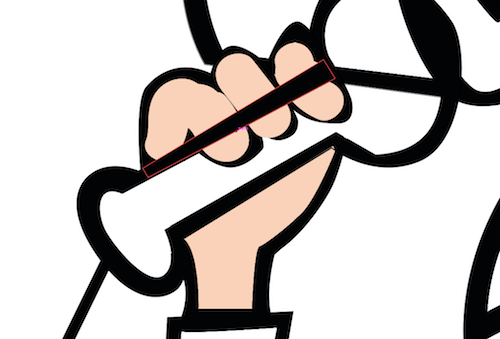
When you color in this fashion, the color is positioned above the path. To motility information technology nether the path, merely select the colour shape and hit ⌘ and [ to move it down.
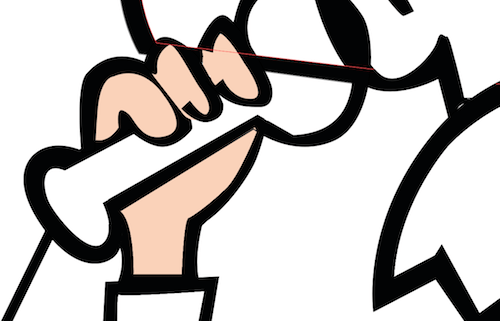
If other objects are overlying the fingers, select them and move them downwardly the same way yous did for the fingers' color. Or you can right-click and select "Suit" → "Send Backward" to send them back.
Go on coloring with these two methods.
Note how the path under Einstein's mustache disappears when you make full the mustache with color:
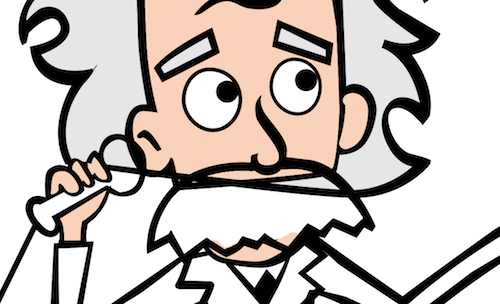
Remember that you can move objects frontward (right-click → "Arrange" → "Bring Forwards" or ⌘ + ] ) or backwards (right-click → "Adjust" → "Send Backward" or ⌘ + [ ) to observe their right position.
Here's our Einstein colored in.
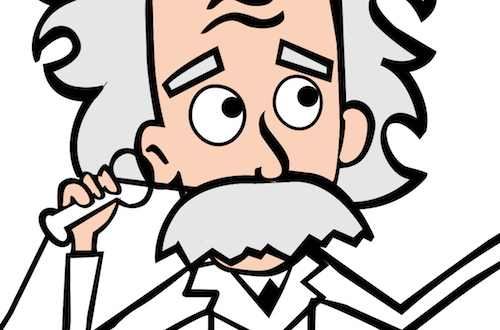
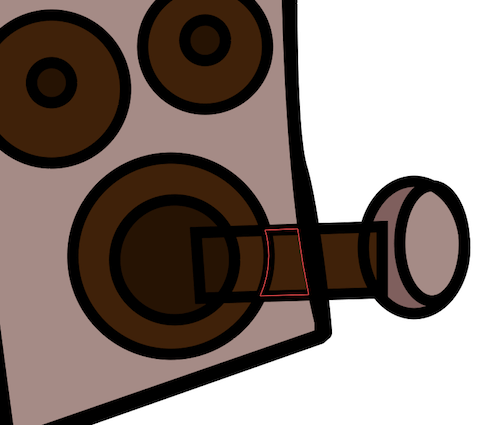
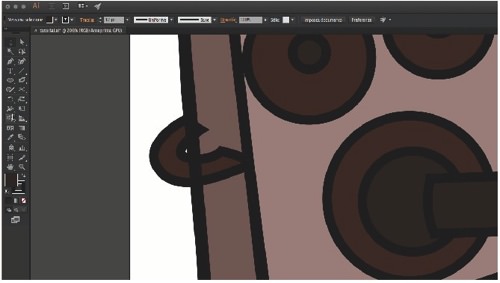
Nosotros still accept to correct something. The antique telephone's handset is divided into pieces because of our previous tracing:
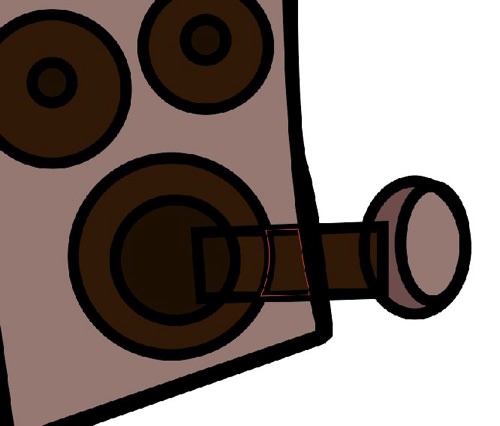
We have to unify these pieces into 1. With the handset selected, enable the Shape Builder tool (Shift + M) and elevate on the objects we need to unify:
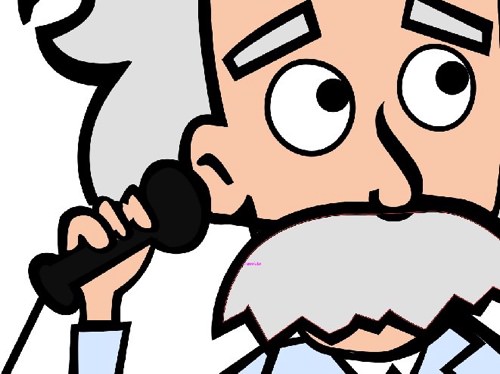
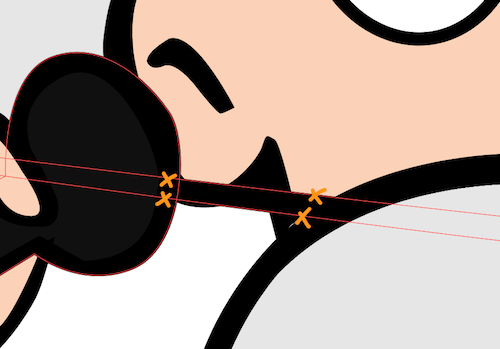
Now, we have to become rid of that line under Einstein'southward ear:
We'll use the Scissors tool ©. Select our two lines and cut them in four places as shown here:
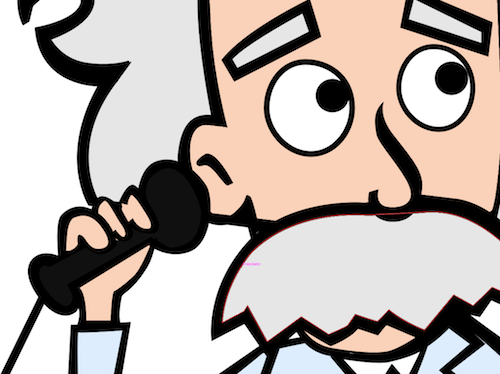
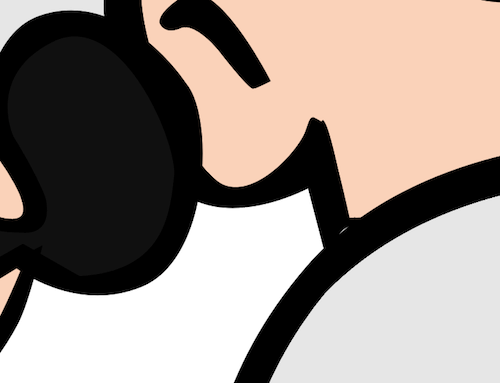
At present, select the cut lines and delete them.
Hither's the result:
3. Environment (Laboratory)
Let's move on to the side by side image.
When nosotros recollect of Einstein, the starting time objects that come up to mind (well, to my mind) are a laboratory and a blackboard.
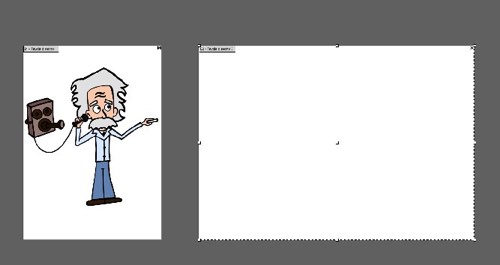
Let'due south draw our laboratory on some other artboard.
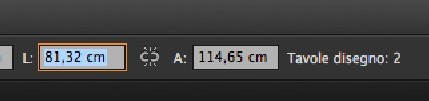
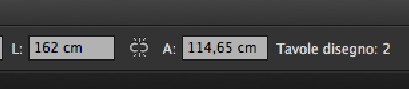
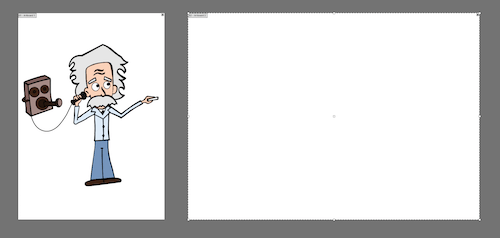
Click on the Artboard tool (Shift + O), so click on "New Artboard" in the menu. You volition get a re-create of your starting time artboard with the same height and width.

Gear up the width to twice that of the previous table:
You should have something like this:
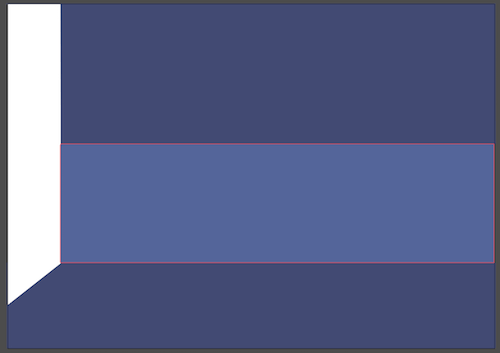
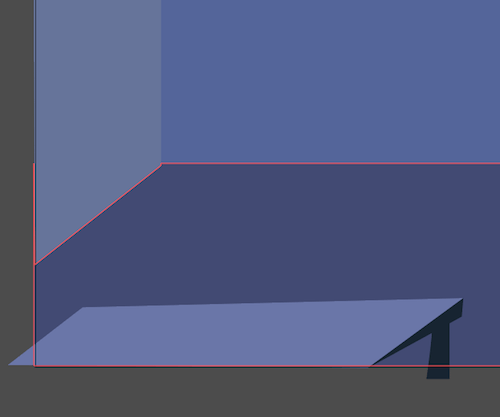
It's time to create the room. We demand a flooring and ii walls. The tones and colors of the room volition be similar considering the room is a background.
The grapheme will stand out considering of the different colors and the thick edges. The uniform tone of the background will serve non to distract from what is happening.
Create a new layer and call it "Room." Block the other layers.
Take the Pen Tool (P) and draw a polygon like the one in my image. Ready the fill color to #424974.
Draw the front wall with the Rectangle tool (M). Divide information technology into two colors, so that we have a more dynamic background. Utilise #53649C for the lesser rectangle, and #424974 for the summit rectangle.

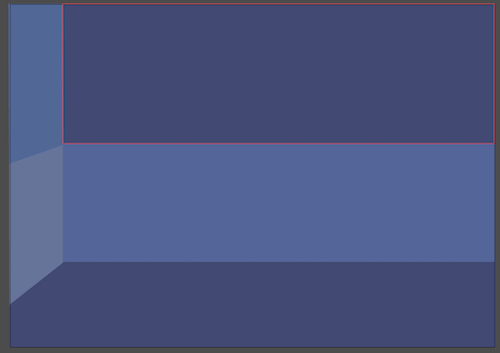
Finally, insert the side wall. You tin apply the Rectangle tool again. Then, put your shape under the flooring by right-clicking, then "Adjust" and "Ship Backward" (or ⌘ + [).
I've split it into 2 shapes. The bottom rectangle is gear up to #65739B, and the summit one to #506799.
In a cartoon laboratory you will detect strange mechanism, buttons, screens and handles. Let'south create our first car, a screen and a handle.
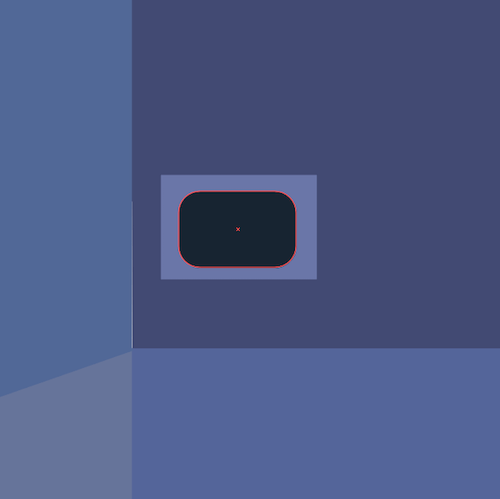
Create a rectangle with the Rectangle tool (M), sized to 587 × 323 pixels and the color set to #6A75AA.
Create some other rectangle inside that with the Rounded Rectangle Tool (M), the color set to #172432.

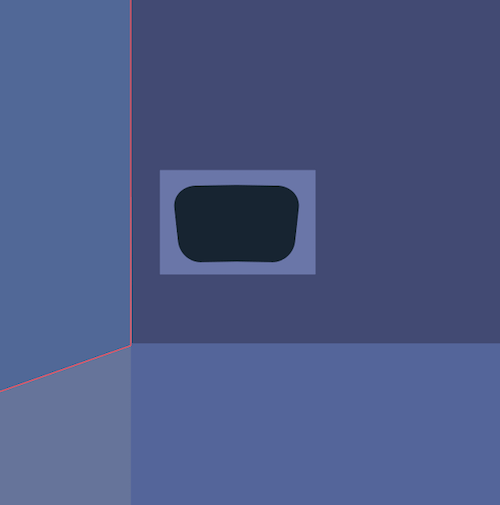
Go to "Upshot" → "Warp" → "Arc" and select "Horizontal." Set the bend to 3%, and nether "Distortion," set "Horizontal" to =0% and "Vertical" to -4%.
With the Pen tool (P), create three rectangles to describe the screen'south sides, as shown beneath.
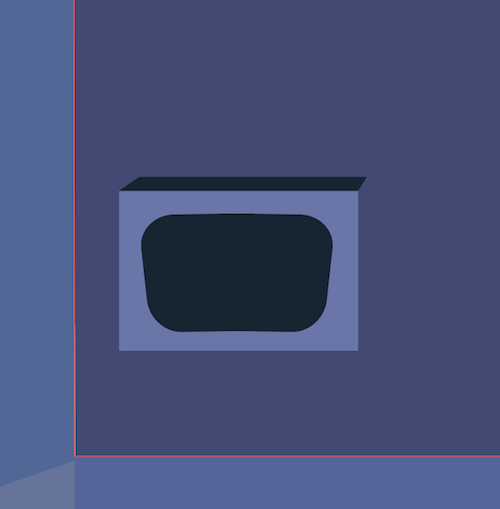
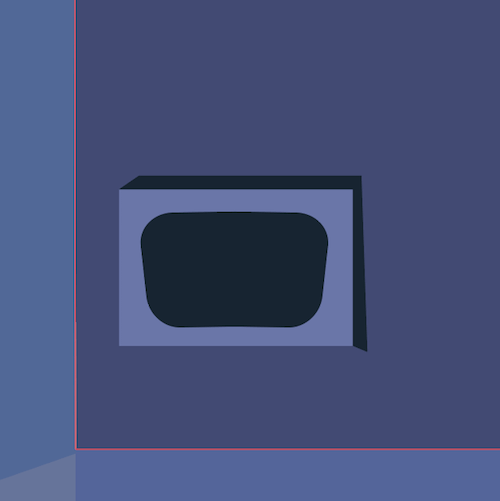
Finally, grab the Pen tool once again and depict a zig-zag line, with the color set to #D8D89C and the stroke weight gear up to 5 points.
Depict a line equally shown here:

Now, create another rectangle with dimensions of 160 × 372 pixels and the color set to #6A75AA. Put it on the side of the first ane.

With the Pen tool, depict the sides of the rectangle, the same way you lot did for the commencement i.

Create some other rectangle inside this 1, with the color set up to #172432.

Create a rectangle again, coming out of the slot, as shown here:

Draw the handle's knob with the aforementioned color.
On the other side, create 2 circles with the Ellipse Tool (L), with the same dimensions as the knob and the colour set up to #6A75AA.

With both circles selected, go to the Pathfinder panel and click on "Minus Back" (or by selecting "Event" → "Pathfinder" → "Minus Back"). You will go this shape:

Apply this to our knob to get a light consequence.
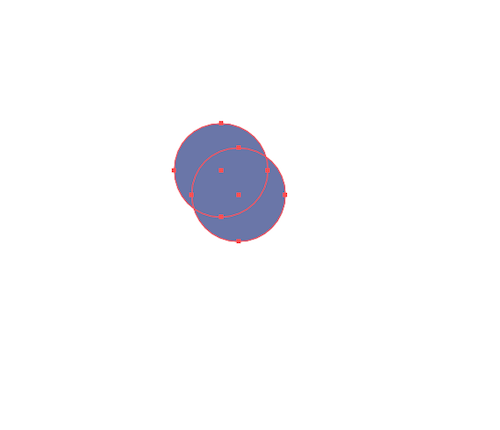
Repeat the same steps to create our 2d motorcar. Describe some shapes, such as trapezoids and circles, with the color ready to #6A75AA.

Practice the same for our third auto, this time with rectangles, circles and squares. You can create every single object by repeating the previous steps.
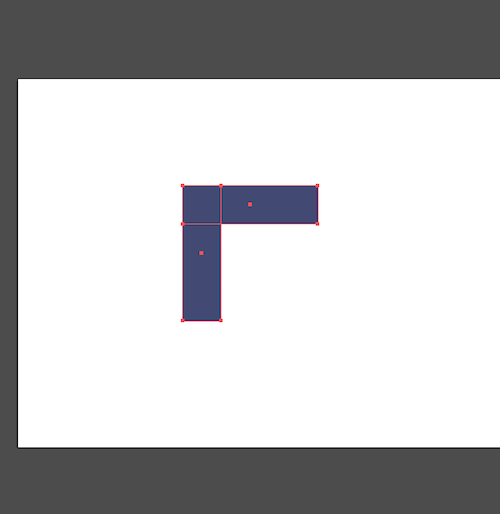
To create the pipe sticking out of the ground, just draw two rectangles with the same dimensions, 560 × 158 pixels.

Correct-click on the bottom pipe and select "Transform" → "Rotate," with the angle fix to 90°.
Make an 50-shape from the two rectangles:

Select both rectangles, go to the Pathfinder panel and click "Unite."
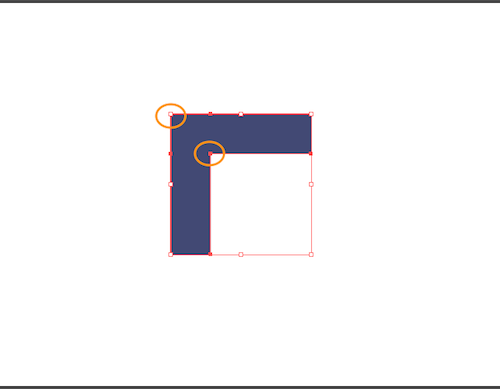
With the Direct Selection Tool (A), select the resulting shape. Some fiddling circles will show upwards, giving you dynamic corners. Click and elevate to the bottom right the ones shown hither:
This is the result:
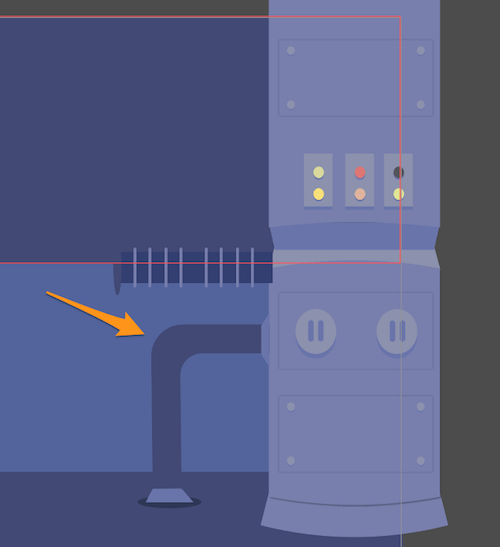
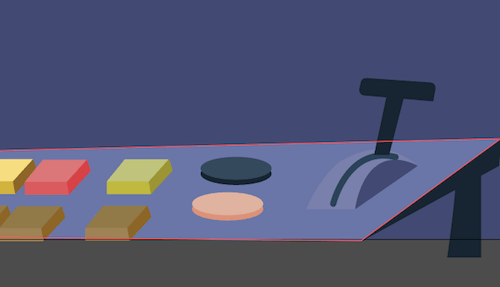
Let's work on the table now.
Describe a elementary rectangle and let it extend by the artboard, so that it appears to be in the foreground.
The colors are #787FAD for the light violet, #6A75AA for the dark violet, and #8C92AD (very light violet) for the lighting.
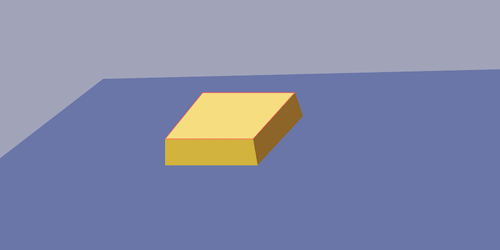
Create a push button with the Ellipse tool (L), prepare to #F7DF79.
Describe sides of the bottom the manner we did with our first auto, the colors gear up to #D3B42F and #8E6621.
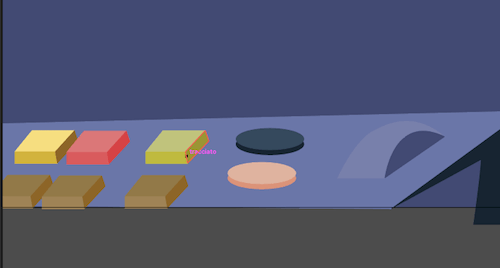
Create all of the other buttons the same way, with the following colors:
- reddish push button: #DD7676, #DB5A5A, #D84141
- green button: #C0C478, #BFBB32, #9B962A
- brownish button: #937A44, #A08453, #8E6621
- blue button: #34495E, #172432
- pink button: #E0B39D, #DD9376
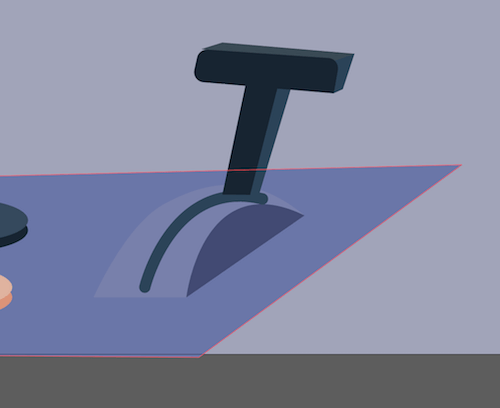
With the Pen tool (P), create a curved shape, with a darker side. This will exist the base of another knob, the colors being #787FAD and #424974:
Create a curved line in the center of the shape, again using the Pen tool. Set up the stroke weight to sixteen points.
Now, create a handle with two unproblematic rectangles.
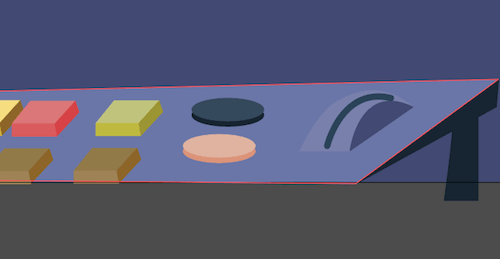
Create the handle'due south sides with our trusty technique, the colors being #172432, #2a4359 and #3a4a56.
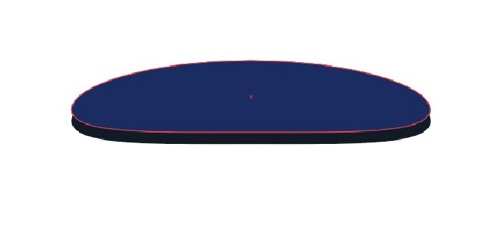
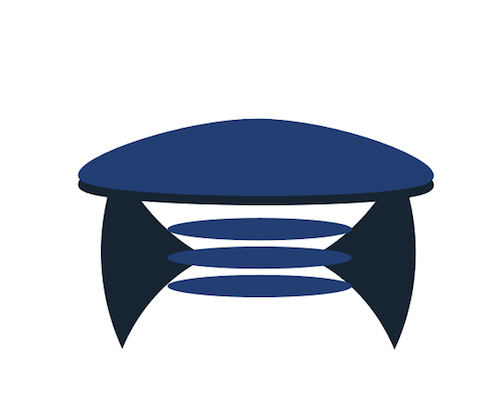
Let'southward create a futuristic table.
Create an ellipse with the Ellipse Tool (L), and drag the ballast points every bit shown here:
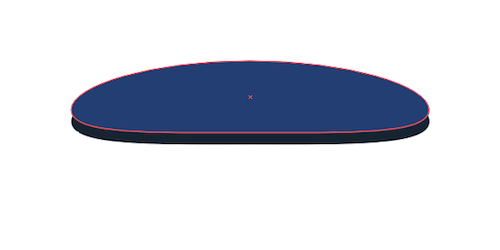
Hit Control + C and Control + B to paste in the dorsum. Movement downward the shape we've simply pasted, and gear up its color to #172432.
Terminate your futuristic table by adding the other shapes as shown below, unproblematic ellipses and two triangles.
I've created a couple of objects on the table as well, a book and a lamp, simply past using shapes, rectangles and the Ellipses tool.
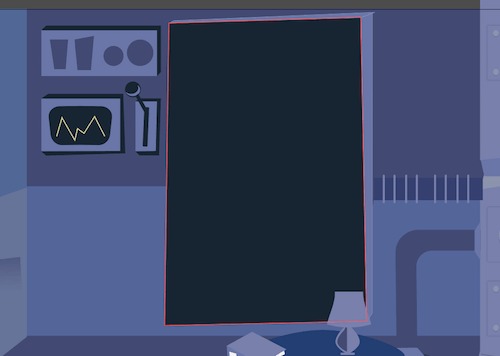
Now, draw a big blackboard for where Einstein will write his formulas.
Have the Rectangle Tool (K) and draw a rectangle, the color set up to #172432.

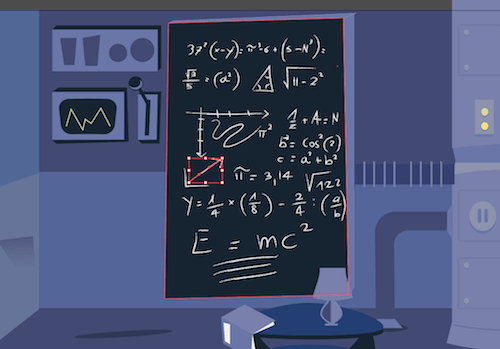
We need to write some formulas on the blackboard, and they need to look as though they're written in chalk.
Grab the Pencil Tool (N) and write some formulas (mine are near all made up!). Set #e6e6e6 equally the colour. When you're done, select what y'all've written, get to the Brushes console, and click on the picayune pointer on the summit right:
Select "Open up Castor Library" → "Artistic" → "ArtisticChalkCharcoalPencil," and select the final type of charcoal, which will give you a cute charcoal effect on the blackboard.
Take the Einstein vector and put it on the side of the blackboard.
4. The Period
The period in which our cartoon is set is nearly 1920. Einstein's theories almost gravitational waves date back to 1918. For this reason, I've inserted an one-time telephone, the kind Einstein would talk on.
5. The Scene
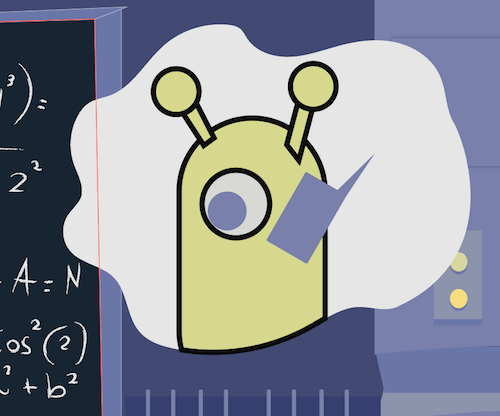
I wanted to put Einstein in a scene in which he's talking with aliens, who are giving him this data. (It is a drawing after all — it should exist a little funny!)
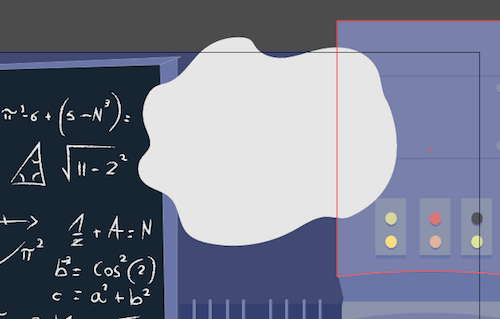
Draw a cloud in the top right with the Pencil tool (N), and so fill up it with white (#ffffff).
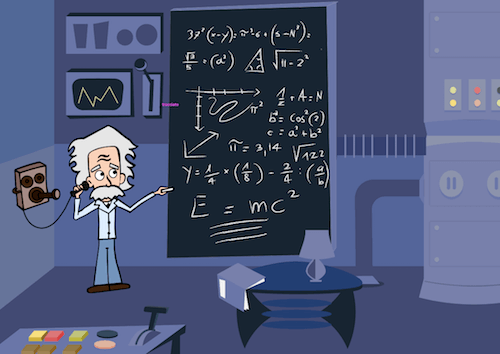
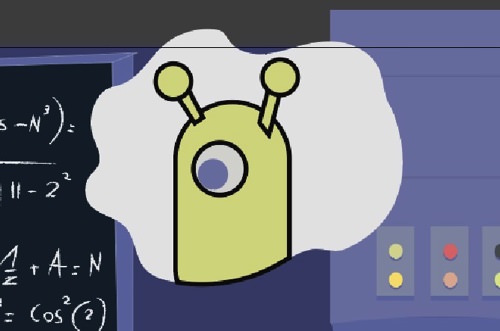
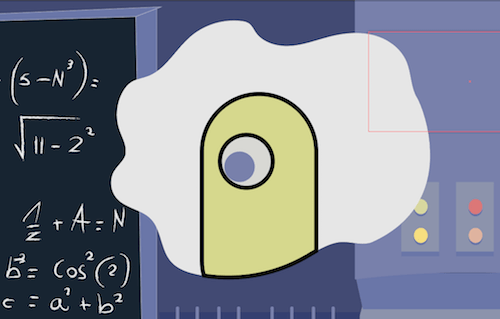
With the Rounded Rectangle Tool (M), draw a rectangle, and circular its corners until they are completely curved. Set the fill to #d6d989 and the stroke to #000000.
With the Ellipse Tool (50), draw an heart and a pupil, setting the colour to #787fad.
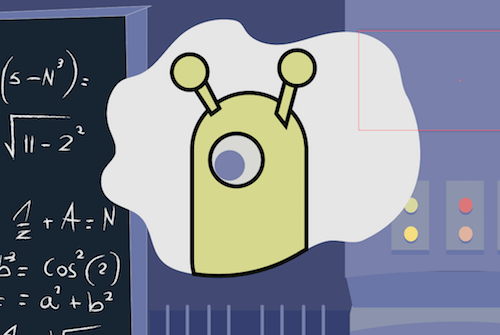
With the Pen Tool and Ellipse tool, draw two petty antennas.
Draw a small rectangle, which will be its phone, and tilt it past grabbing an angle and drawing the cursor downwardly.
With the Pencil tool, describe a manus holding the phone and some lines for the telephone's signal.
Decision
Nosotros're done!
I hope you've liked this tutorial. Experience free to leave a annotate below, and show u.s. your cartoon! Terminal but not least, some of y'all were request a high-res epitome of Einstein. So here you go:
 (al, jb, ms, ml)
Source: https://www.smashingmagazine.com/2016/03/drawing-a-cartoon-in-illustrator/
0 Response to "how to draw 3d cartoons in illustrator"
Publicar un comentario